
Dr. Daisy Z. Akgonullu publishes her latest work in Food Hydrocolloids
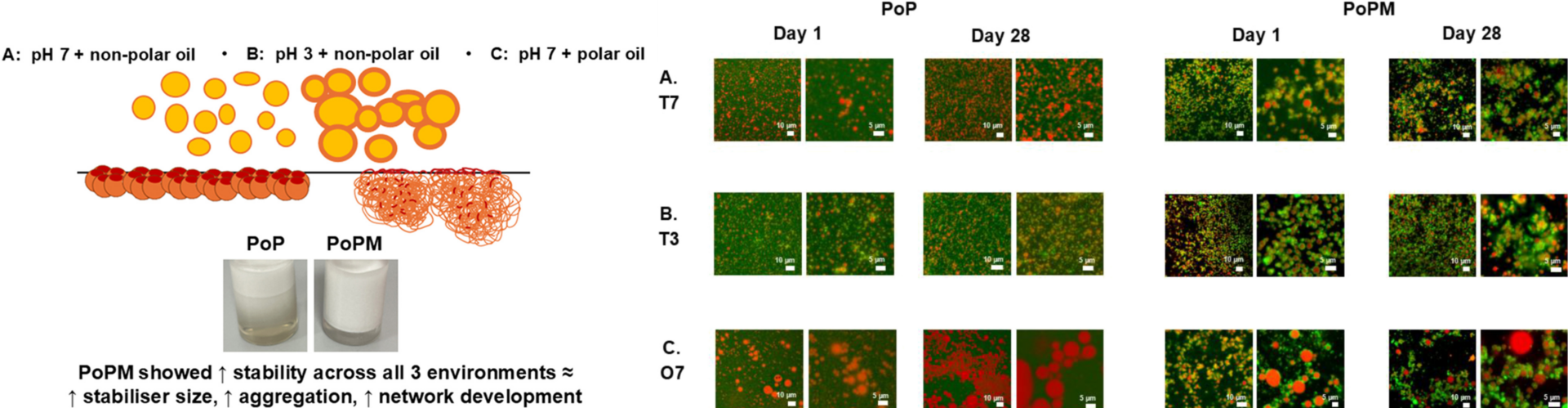
Dr. Daisy Akgönüllü (former PhD student, EPSRC SoFI CDT and PepsiCo) publishes her latest work titled "Pickering emulsion stabilisation by potato protein microgels: effect of pH and subphase", where she focused on research question on how potato protein microgels stabilise emulsions of two ‘oils’ of very different polarity (tetradecane, octanol) at acid (pH 3) and neutral pH (pH 7), in comparison to non-gelled potato #protein. In collaboration with ETH Zurich and PepsiCo and combining complementary techniques such as interfacial rheology with a subphase exchange system, small angle X-ray scattering (#SAXS) besides other colloidal techniques, this study demonstrates microgels maintain strong emulsion stability via the formation of viscoelastic interfacial layers surrounding oil droplets but also via an aggregated network of oil droplets that spans the bulk emulsion phase. In fact, the 4x larger size of the potato protein microgels and their aggregates compared to potato protein appears to be the main factor giving microgel-stabilised Pickering #emulsions better stability, by creating thicker viscoelastic layers with greater steric repulsion offering more consistent emulsion stability across the varying environmental conditions and sub-phases. Overall, this study highlights the importance of understanding how using alternative protein microgels may offer benefits to interfacial stabilisation when the polarity of subphase varies, such as stabilising essential oils versus vegetable oils, which has been relatively underexplored in the literature. The full text can be assessed here: https://doi.org/10.1016/j.foodhyd.2026.113013